


A few weeks ago I ran a student’s trade history through EdgeBuilder (our proprietary trading analytics engine). I’ll call him Ray (not his real name).
By every top-line number, Ray is a losing trader. His overall profit factor is 0.7. In plain terms: for every dollar his losing trades cost him, his winning trades clawed back seventy cents. That is the number that more often makes people quit. It’s the number Ray had been staring at for months, and it had already hardened into a belief of “I can’t do this.”
Ray was wrong. Not about the 0.7. That part is real and undeniable as the account loses money. But buried inside that losing account were two clean, profitable edges he couldn’t see.
Here’s why he couldn’t, and why few losing traders can.
The Brain Reports the Overall Summary. The Performance Lives in the Details
Unless you’re Rain Man, your brain does not keep an accurate ledger of your trading. What it does keep is an overall ‘gestalt’ or feeling about your trading. Lamentably, that feeling is weighted toward the negative more than the positive. It’s called the negativity bias whereby equal losses weigh (neurologically) ~2x more intense in your brain as equivalent gains. This is not a problem unique to you - it’s biological hardware and software working against you.
Now when you sprinkle on a few more cognitive leanings like recency bias and salience, you’re more likely to remember your biggest losers vs your biggest winners. The four quiet base hits you took in the final hour of the session leave almost no mark if they’re about equal to one big loss.
What’s worse is you’re more likely to judge yourself on one number. The account P&L, which will often turn into a single verdict that fuses your biases into a single conclusion (“I can’t trade profitably”).
But herein lies the problem as your trading strengths and weaknesses aren’t generally accurate in how you feel about yourself. This is why when it comes to trading, I prefer data, not opinions or feelings.
So we pulled Ray’s data apart. And what we found shocked us, and him.
Edge #1: His Money Has a Timer
From Ray’s EdgeBuilder report
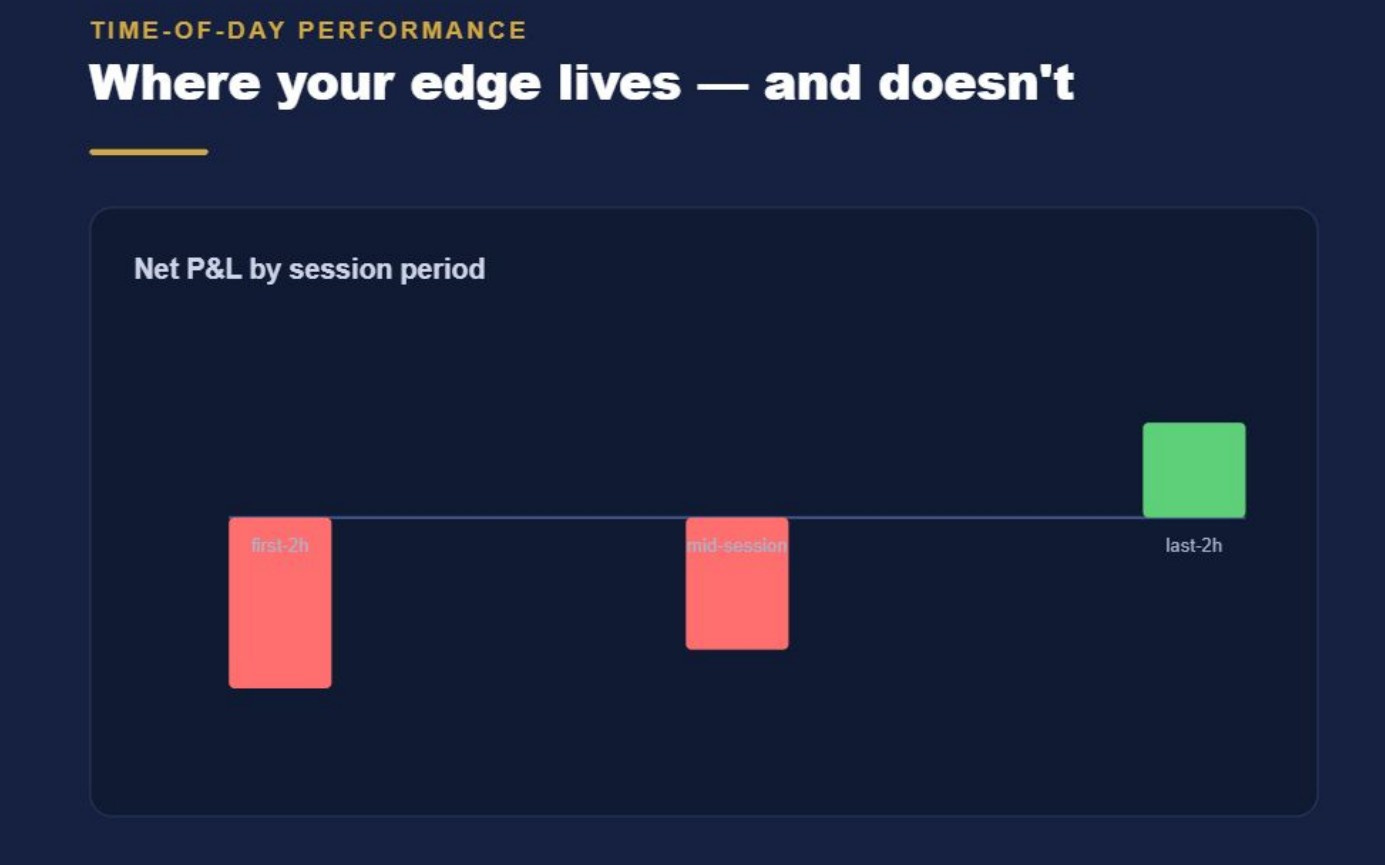
In the chart above, you can see three windows of time. In the first two hours of the session: Ray is red. Mid-session: also red. But, in the last two hours: Ray’s green, and it’s the only green on the chart.
Read that literally. Every dollar of net-positive contribution in Ray’s trading comes from a single two-hour window at the end of the day. The rest of his trading day isn’t neutral, but a charity to his broker. He spends the morning and midday paying for the privilege of trading his one good window. If he simply hadn’t traded before 2pm, his equity curve would look like a different trader (a profitable one).
He had no idea (neither did I till I viewed the data). I asked him where he thought his edge was, and he shrugged. The time of session data was invisible to him because no single trade tells you this, only the pattern does, and the pattern only shows up when you stack hundreds of them by time of day.
Edge #2: Ray’s Strategy Has a Unique Configuration
From Ray’s EdgeBuilder report
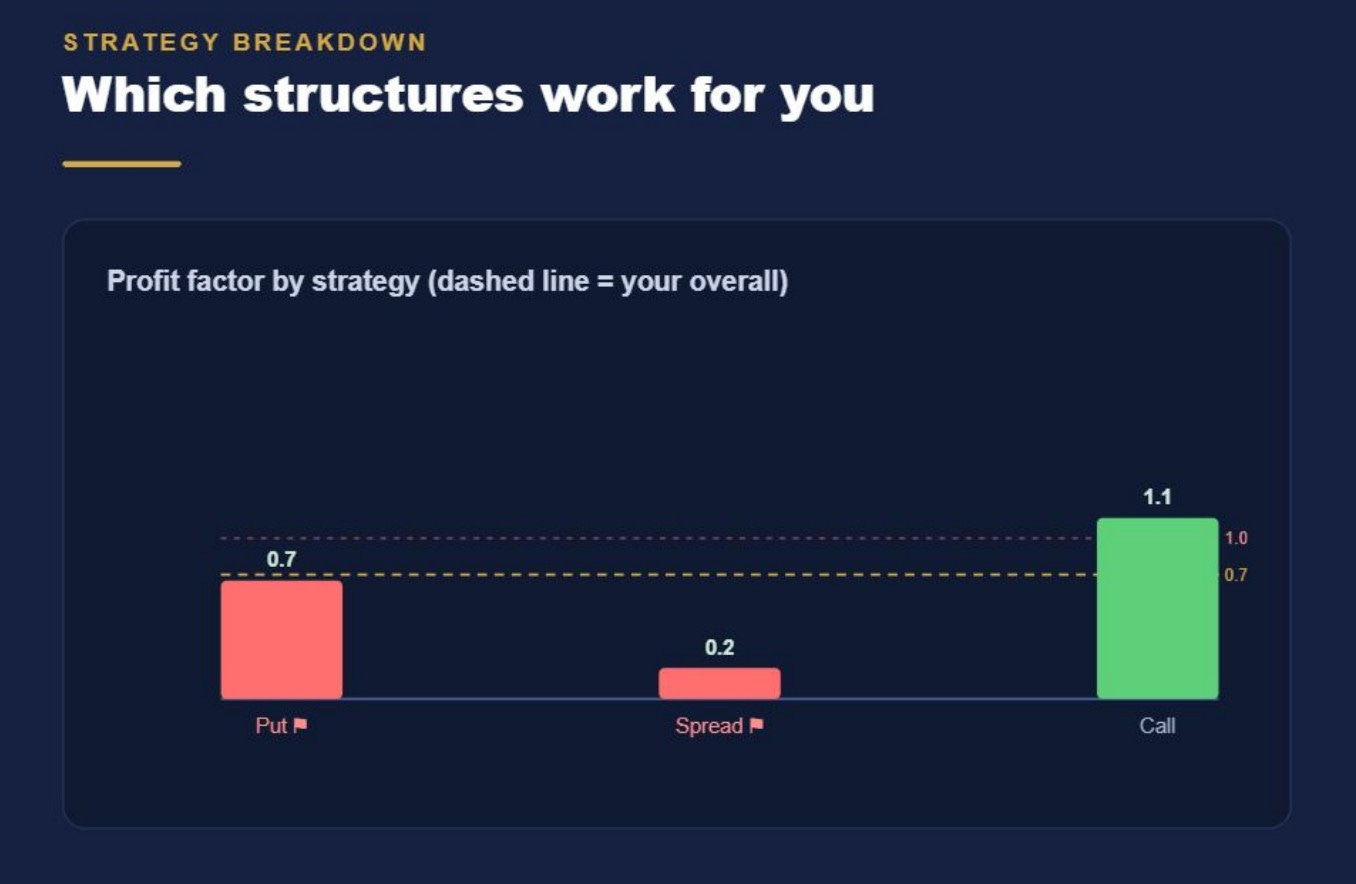
When we look at all the various option strategies Ray uses, there’s a clear structure. Puts have a profit factor of 0.7. Spreads were 0.2. Calls however had a 1.1 profit factor. The dashed line is his overall average at 0.7 with the reference line being 1.0 (or breakeven).
Ray traded puts, spreads and calls. When he traded spreads, he was hemorrhaging losses shedding $1 for every $.20 he gained. It turns out that single strategy is bleeding money fast for him.
Now, I’m not going to oversell the calls as 1.1 is a mild but workable edge. It’s not something you’d frame on a wall, but it makes money for him. The problem was this small but workable edge was being destroyed by his losses, which led him to believe he was a losing trader overall. That’s the cognitive and biological trap most traders fall into.
This is the thing almost nobody tells you
Most traders are not one indicator, one strategy or one setup away from being profitable. The dividing line for Ray is most likely your story - that you are already profitable in one small way, but you dilute that edge by trading in other ways that cost you money.
Almost all edges are narrow by nature. The market pays you for the specific thing you do well, and taxes you (in full), for everything you insist on doing around it. But you cannot find your edge from feelings alone, because your feelings are likely an inaccurate representation of what you do well (and what you don’t). This is why you need the data broken down and teased apart, likely by someone other than you.
Seeing the data of where your strengths lie is the first part of this process, but that is the easiest part. The next step requires the real work, and this is rarely done ‘alone’. If you could have found out the dividing line between you and success, you’d have already done it by now.
That’s exactly what we built our Group Mentoring to do.
Cohort 1 starts Friday, July 10 — 11:00am EST. Eight weeks.
On July 10th, this upcoming Friday, we’ll start with our first ever Group Mentoring, a service normally only for private students.
We’ll start with your data and create your personal EdgeBuilder report just like we did for Ray. We’ll isolate your three biggest leaks, repair them one at a time, then optimize your exits, stop losses and take profits so the edge you already own stops leaking to the trades you should avoid.
Private Mentoring is normally $6500 (minimum) for one person. By doing it in a group, you’ll get personalized training at a fraction of the price.
The cohort is capped with only 21 seats left, and once it’s full, the door closes.
If you’ve been staring at your own underperforming profit factor, wondering whether you’re just not built for this, you may be reading the wrong numbers or data points. Come join the group mentoring and find the right ones.
→ Claim your Group Mentoring seat before they run out.
The positioning + flow don’t lie...but the brain might.
Chris Capre · Founder, 2ndSkies Trading · MSc Neuroscience Candidate, University of Florida
A most insightful article, Chris.
I imagine many traders are unaware of their “shadow edge” and would benefit greatly from someone exposing it to them in a data-driven approach.