


I’ll confess, I wasn’t expecting such ‘hawkish’ language from new Fed Chair Warsh on Wedsnesday. On Jun 17th at 230pm EST, during the Fed presser, Warsh gave traders a masterclass in how quickly the brain can override a trading plan.
During his first press conference, Warsh sent the S&P 500 down over 1.2% into the close with bond yields spiking and the VIX jumping 12%, all because the dot plots revealed nine Fed officials projecting rate hikes this year, with Warsh himself offering no forward guidance whatsoever. For many traders, it felt like a shock.
But then Thursday came, and the market recovered, dusting most of the losses off. If you sold Wednesday into the close, you likely watched Thursday’s recovery from the sidelines. If you held, you rode out something that felt genuinely threatening in the moment. Either way, your brain (and biology) was likely running the show, not your trading plan. That discomfort wasn’t weakness. It was your brain doing exactly what it was designed to do.
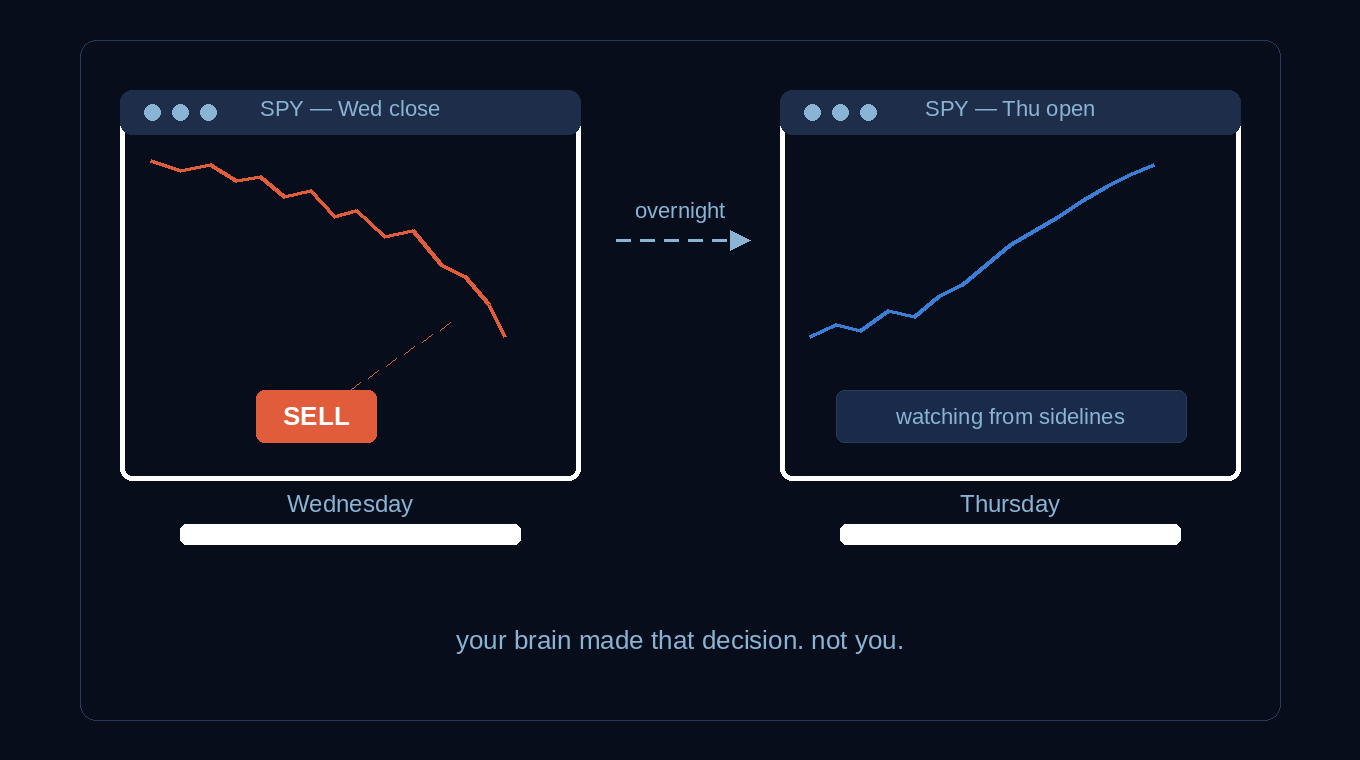
The problem comes down to this: what your brain was designed to do and what you need it to do in a highly volatile environment are almost diametrically opposed. In today’s article, I’m going to shift from focusing on market structure or flows, and shifting to biology, particularly how that neural tissue between both ears is both friend and foe when it comes to trading.
The Threat Response Costing You Money
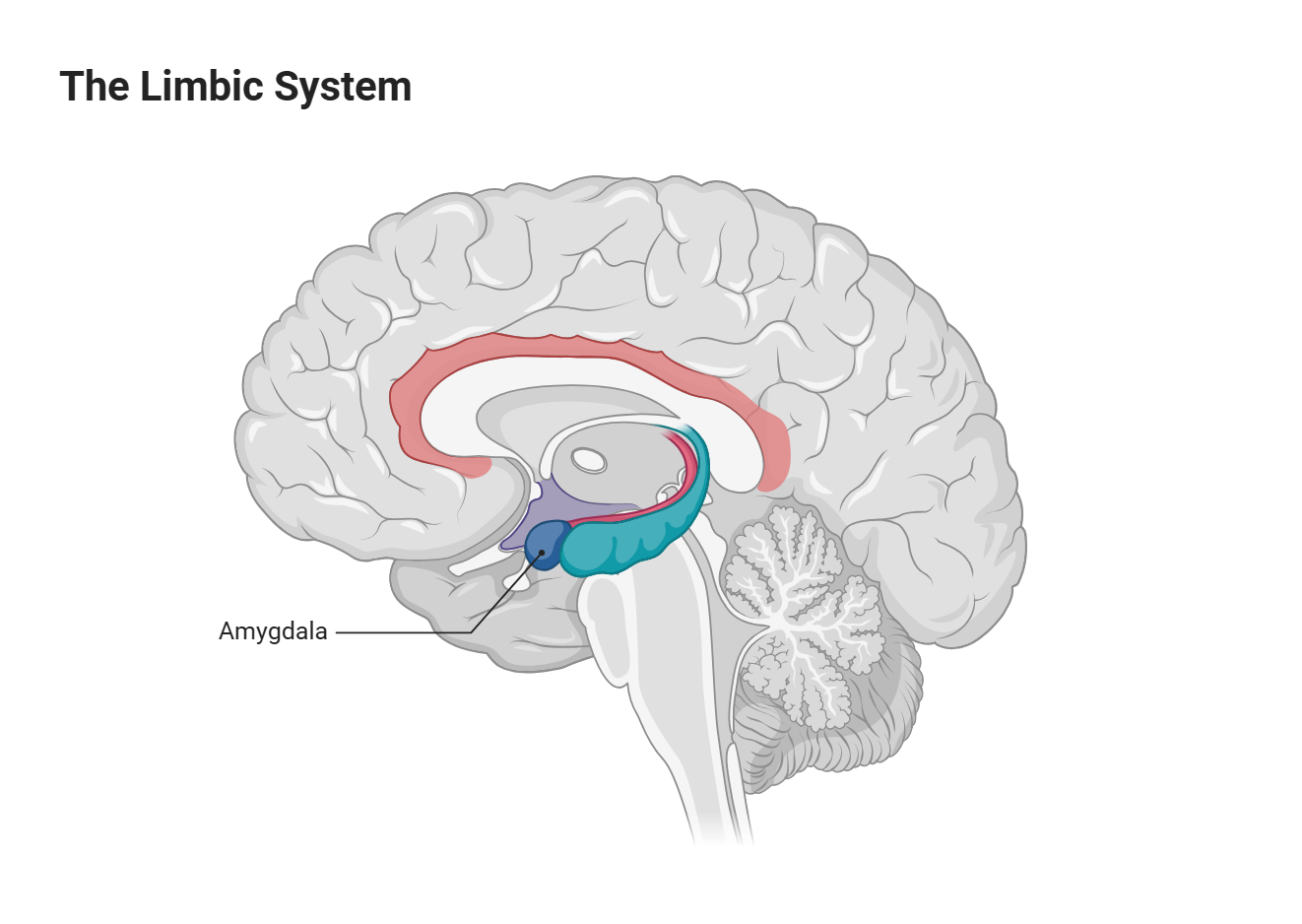
When you watch a position move sharply against you, your brain doesn’t register it as a financial event. It registers it as a threat. The same neural circuitry that evolved to respond to physical danger, the amygdala, which is part of the HPA axis (hypothalamic-pituitary-adrenal axis) and the sympathetic nervous system, will activate in response to a losing trade with remarkable similarity to how it behaves when you’re in genuine physical danger.
The results are:
-Cortisol and adrenaline flood your system
-Heart rate elevates
-Attention narrows
The prefrontal cortex, which is the part of your brain responsible for deliberate reasoning, planning, and impulse control, goes partially offline as the brain routes resources toward faster, more automatic responses. This is the amygdala hijack, and it happens on a timescale of milliseconds, long before your conscious mind has processed what’s happening.
Created in https://BioRender.com
The result: you make decisions that feel urgent and necessary but are actually driven by a threat response rather than analysis. You exit a position at the worst possible moment because holding it feels physically intolerable. You re-enter too quickly because sitting in cash while the market moves feels like missing out, which (ironically) the experience of FOMO is something the brain also registers as a threat. You increase your size to make back losses faster, which is the trading equivalent of running toward the thing that scared you.
None of this feels irrational in the moment. It feels like exactly the right thing to do. That’s what makes it dangerous.
Why Last Week Was Particularly Hard on Your Brain
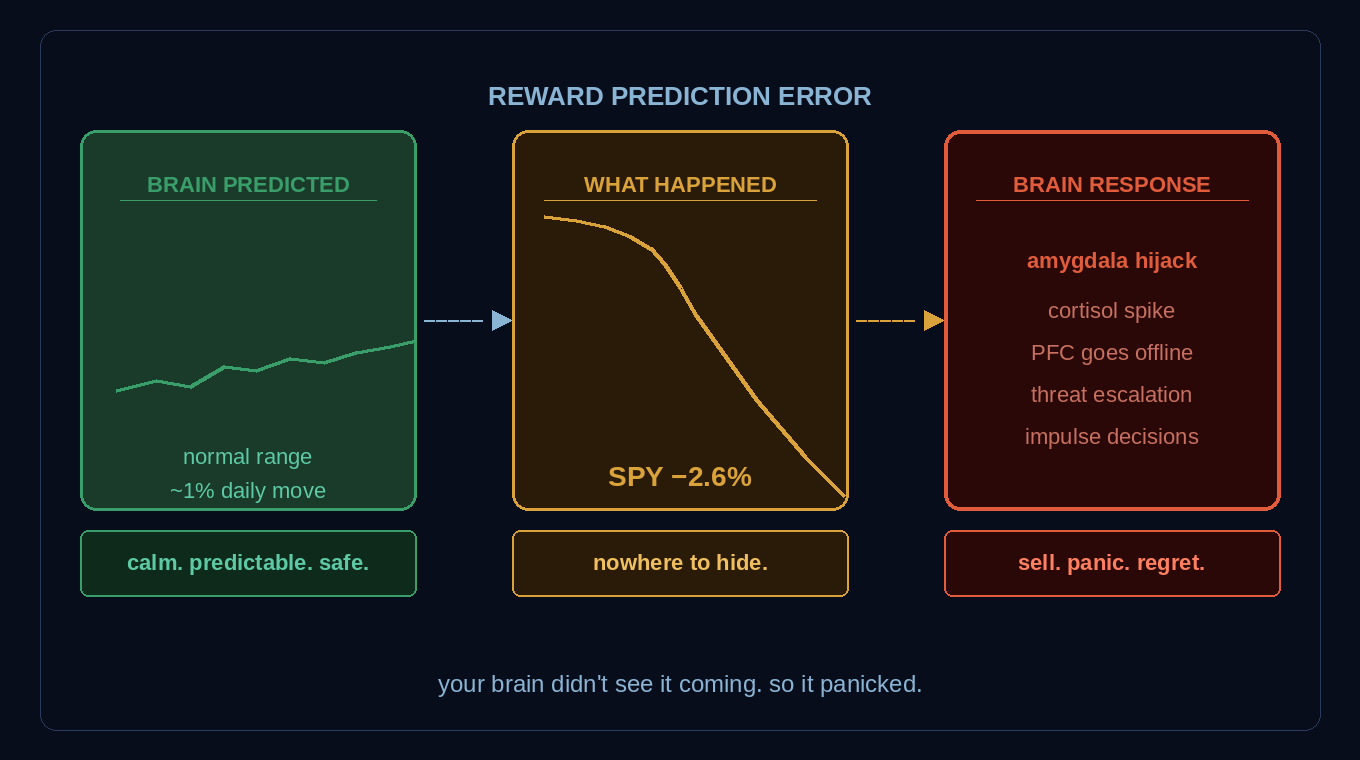
Normal volatility is manageable because the brain can habituate to repeated, predictable stress. A stock that that normally moves 1% a day becomes background noise on anything ~1%. But last week’s volatility wasn’t normal volatility.
What makes sudden, unexpected volatility spikes neurologically different is that they violate the brain’s predictive model. This is called RPE (reward prediction error). You may not know this, but your brain is a prediction machine which is constantly generating expectations about what’s about to happen (in your environment) based on recent patterns. When those expectations/predictions are violated sharply, the brain’s threat response often doesn’t adjust properly and escalates the threat analysis.
The cross-asset selloff made it worse. When equities, bonds, and gold all sell off together, the brain loses its normal reference points for “safety.” There’s nowhere to look that confirms the threat is contained. That perceptual trap (no safe harbor) is one of the most reliable triggers for panic-driven decision making in trading.
What Actually Helps
The standard advice, which you’ve all heard before, like “stick to your plan,” while technically correct is practically useless in the middle the amygdala hijacking your prefrontal cortex. You can’t think your way out of a threat response that’s operating below the threshold of conscious thought.
What actually works is physiology first, cognitive strategies second.
The fastest physiological way to bring the prefrontal cortex back online is via controlled breathing, specifically, extending the exhale longer than the inhale. A four-count inhale followed by a six to eight count exhale activates the parasympathetic nervous system and begins to counteract the cortisol response within a few breath cycles. This isn’t meditation advice. It’s basic autonomic nervous system regulation, and it works fast enough to matter in a trading context.
In Closing
Last week tested a lot of traders. If your decision making held up, notice what made that possible. If it didn’t, notice that too, not so much as a failure of discipline, but as data about how your nervous system responds under stress.
That data is more valuable than any pattern on your chart.
The neuroscience of why traders make the decisions they make, and what you can actually do to change that, is something I’ll be writing about monthly here in Second Sight. It’s also the subject of a book I’m working on. More on that soon.
— Chris
The positioning + flow don’t lie...the brain might.
Chris Capre · Founder, 2ndSkies Trading · MSc Neuroscience Candidate, University of Florida