


Trading the SpaceX IPO: The Good, the Bad, and the Ugly
SpaceX filed its IPO on May 20th, and the document tells you everything you need to know about how Elon Musk sees the world, along with how he expects investors to see it too. The first dozen pages are rocket photos. The word “AI” appears hundreds of times. The prospectus (which feels very ‘WeWork’) reminds you that humanity must avoid extinction (thanks for that insight Elon) and the only way to do this is to become multi-planetary. Lastly, the company is being valued at roughly 100x price-to-sales, a ratio that has no historical precedent for a business of this size.
Set aside the spectacle and hoopla of one of the most historical IPO’s in my lifetime. In this article, I’m going to share how I’m trading it, and what I expect going forward.
The Pre-IPO Trade: NASA as the Proxy
Most retail traders can’t access SpaceX in the private equity markets. But there is a back door: NASA, the Tema Space Innovators ETF, owns roughly 10% of SpaceX shares via an SPV. Since launching in late March, NASA is up approximately 62% in eight weeks, with volume surging as the IPO date approaches (currently anticipated June 12th). I’m already positioned — long shares and a bull call spread targeting $45 for the July expiration, with some option traders already eyeing $50.
4hr Chart NASA ETF
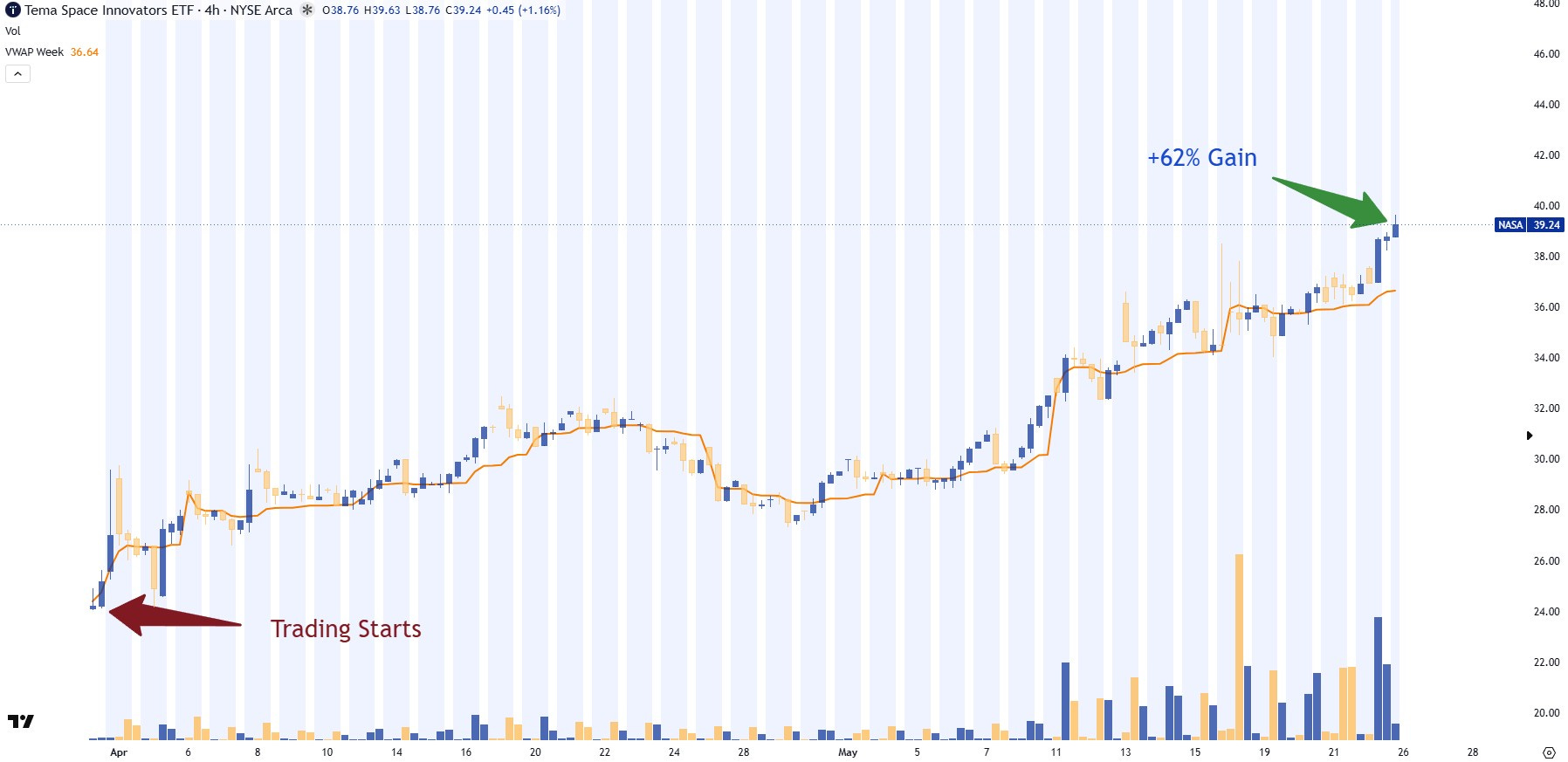
This is frontrunning the IPO by proxy, and it’s working precisely because retail demand for SpaceX exposure has virtually nowhere else to go right now. That dynamic doesn’t reverse until the IPO goes live or the narrative breaks. Neither looks imminent.
Once SPCX Goes Live: What to Expect
The mechanics of the post-IPO period are fairly predictable. Retail traders with apparently endless conviction in Elon will likely buy aggressively. Institutions with Nasdaq exposure will be forced to buy as SpaceX qualifies for the Nasdaq-100 fast-entry rule, meaning an index inclusion roughly 15 days after listing. This will trigger hundreds of billions in structural buying from funds that track the index whether they want the exposure or not. Options will go live within days to weeks of the IPO and will likely see over a million contracts in a single session within the first month via a combination of day traders and long-dated LEAP bets in both directions.
My overall take between the IPO and the six-month lockup expiration: bullish, primarily because of the structural forced-buying dynamic. This isn’t a fundamental call. It’s a call on the forced buying mechanics + retail driven mania.
The Lockup Period = the Most Important Date on the Calendar
The most underappreciated event in the SpaceX IPO timeline isn’t the listing, it’s the lockup expiration six months later. That’s when current shareholders, many of whom have been holding for years at far lower valuations, are legally permitted to sell. At a $1.75 trillion valuation, the profit-taking incentive will be enormous. If the stock has been carried higher by structural buying and retail momentum, the lockup expiration could be one of the most significant supply events in stock market history. Mark the date and make sure to build your positioning around it.
The Long-Term Case: Starlink Is Excellent…But SpaceX Is Not Just Starlink.
If SpaceX were purely Starlink plus launch services, this would be a straightforward buy. Starlink generated $11.4 billion in revenue in 2025, up 48% year over year, with $4.4 billion in operating profit. It’s a genuine monopoly in satellite broadband with 10.3 million subscribers across 164 countries and a subscriber growth rate that’s accelerating. I generally don’t like to bet against monopolies.
But SpaceX is not just Starlink. And that’s where the valuation story gets difficult.
xAI, now rebranded as SpaceXAI following its February 2026 acquisition, burned ~$6.355 billion in operating losses in 2025 and posted a $2.469 billion operating loss in Q1 2026 alone on $818 million in revenue. Starlink’s cash flow is effectively subsidizing Musk’s AI ambitions, and those ambitions are expensive. xAI currently sits behind Anthropic and OpenAI in the LLM race by most credible benchmarks, meaning SpaceX is paying billions of dollars per quarter to compete for fourth place.
X (Twitter) continues to struggle. Ad revenue declined $100 million in Q1 2026 as the company overhauled its ad technology, which is a stark contrast to Meta, Pinterest, and Reddit, all of which posted advertising growth in the same period. Subscription revenue is growing, but not at a pace that closes that gap.
SpaceX also purchased over $100 million of Cybertrucks from Tesla, a related-party transaction that produced a loss for the company. These are the kinds of details that read differently once public market scrutiny becomes more widespread/known.
Then there are the longer-term bets embedded in the prospectus. Data centers in space face a fundamental engineering problem: heat. Data centers produce enormous thermal output and require aggressive cooling infrastructure. In a vacuum (i.e. space), convective cooling doesn’t exist. The engineering costs to manage thermal load in orbit is not trivial, and the prospectus doesn’t address it seriously. Point-to-point rocket travel, like Singapore to London in 30 minutes, is presented as a near-term product without addressing the passengers having to endure 3G’s, the acoustic reality of frequent large rocket launches, or the global launch pad infrastructure required to make the economics work. These are not minor footnotes. They’re foundational product challenges.
Bottom Line
The consolidated numbers tell the story plainly: $18.7 billion in revenue in 2025, $4.9 billion net loss, with Q1 2026 showing a net loss of $4.3 billion on $4.7 billion in revenue, which translates to the losses accelerating faster than revenue can absorb them.
My long-term view: SpaceX is likely down 50% or more between six months (end of lockup period) and a year from its IPO date. You cannot indefinitely paper over $2.5 billion quarterly AI losses, a struggling social media platform, and a 100x price-to-sales valuation with rocket photos and extinction prevention narratives. Eventually, the market prices what’s actually in the filing.
Between now and the lockup expiration, trade it aggressively (bullish and bearish based on the PFP system) as the volatility and trading volumes should be fun to play with. After lockup, I say “buyer beware”.